

It feels like every week there’s a new list of AI tools that you absolutely have to try. You see them on LinkedIn, you hear about them from colleagues, and maybe you’ve even bookmarked a few with the hope of getting to them later. I for sure have plenty of those bookmarks in my browser but honestly I never go back to check them. And when I notice that my browser is slow and get to a cleanup, I am wondering why those tools were saved there in the first place.
That list just keeps growing for many of us, and the pressure to do something with AI turns into a confusing fog of too many options. This is a conversation I have all the time with founders of service businesses, and the real question they want an answer for is where to invest in AI first for the most return with the least amount of risk.
The instinct is often to grab a tool and see what it can do, but that’s like buying a bunch of new kitchen gadgets without knowing what you want to cook. You end up with a cluttered counter and no dinner.
What I recommend to these to these leaders, is to take a step back and ask different questions. I tell them to focus on strategy before any implementation. As a recent article in the Harvard Business Review puts it, the goal is to define the business objectives first, and only then ask how AI can help achieve them (“10 Questions to Help Business Leaders Navigate AI Adoption,” 2024). It’s a shift from chasing trends to solving real business problems, and it starts by looking inward.
Stop looking for tools, start looking at your tasks
The most common mistake I see is starting the AI conversation with a list of tools. A founder will come to me with twenty different apps they want to try for everything from marketing to operations. The real work, however, is to set that list aside for a moment and create a different one: a list of your company’s problems and processes. The most valuable answers for your business aren’t in a tech newsletter, they are inside your own operations.
Before you can pick the right tool, you have to deeply understand the job you want to hire it for. Is your team spending half of every Friday manually compiling client reports? Is your sales process slowed down by the time it takes to write new proposals? These are the kinds of specific, time-consuming issues where AI can provide real help. A recent guide from BCG notes that successful AI adoption is about “applying AI to solve your biggest problems,” not just sprinkling it around the edges (“The Leader’s Guide to Transforming with AI,” 2024). By focusing on the work itself, you move from collecting interesting new technologies to making targeted investments that give you and your team a valuable resource back: time.
How to conduct a simple one-week task inventory
To find your best starting point, you first need a clear picture of where your team’s time is currently going. This is where a task inventory helps. It sounds complicated, but it’s really just about paying attention for a short period.
Here’s how to do it:
- Set a timeframe. Ask your team, including yourself, to track their tasks for one full work week. Five business days is usually enough to see the important patterns.
- Use a simple tool. A shared document, a spreadsheet, or even just a notebook is perfectly fine. The goal is to make it easy to jot down tasks as they happen, not to create another complex process.
- Record everything. Encourage everyone to be detailed. “Wrote a proposal” is good, but “Spent 3 hours gathering information, writing a first draft, and formatting a proposal for Client X” is much better. Include everything from major project work to internal meetings and administrative chores.
At the end of the week, you won’t have a perfect, minute-by-minute record of every single thing, and that’s okay. What you will have is a rich collection of raw data that shows you the reality of how work gets done in your business. This list is the foundation for your analysis.
A clear way to prioritize AI projects
Once you have your list of tasks, you need a simple way to sort through them and find the best candidates for an AI pilot project. I use a straightforward 2×2 matrix to help founders do this. It helps you decide where to invest in AI first by mapping each task based on two simple questions.
Imagine a square divided into four quadrants.
- The vertical axis is “Time Consumed,” from low at the bottom to high at the top.
- The horizontal axis is “Repeatability,” from low on the left to high on the right.
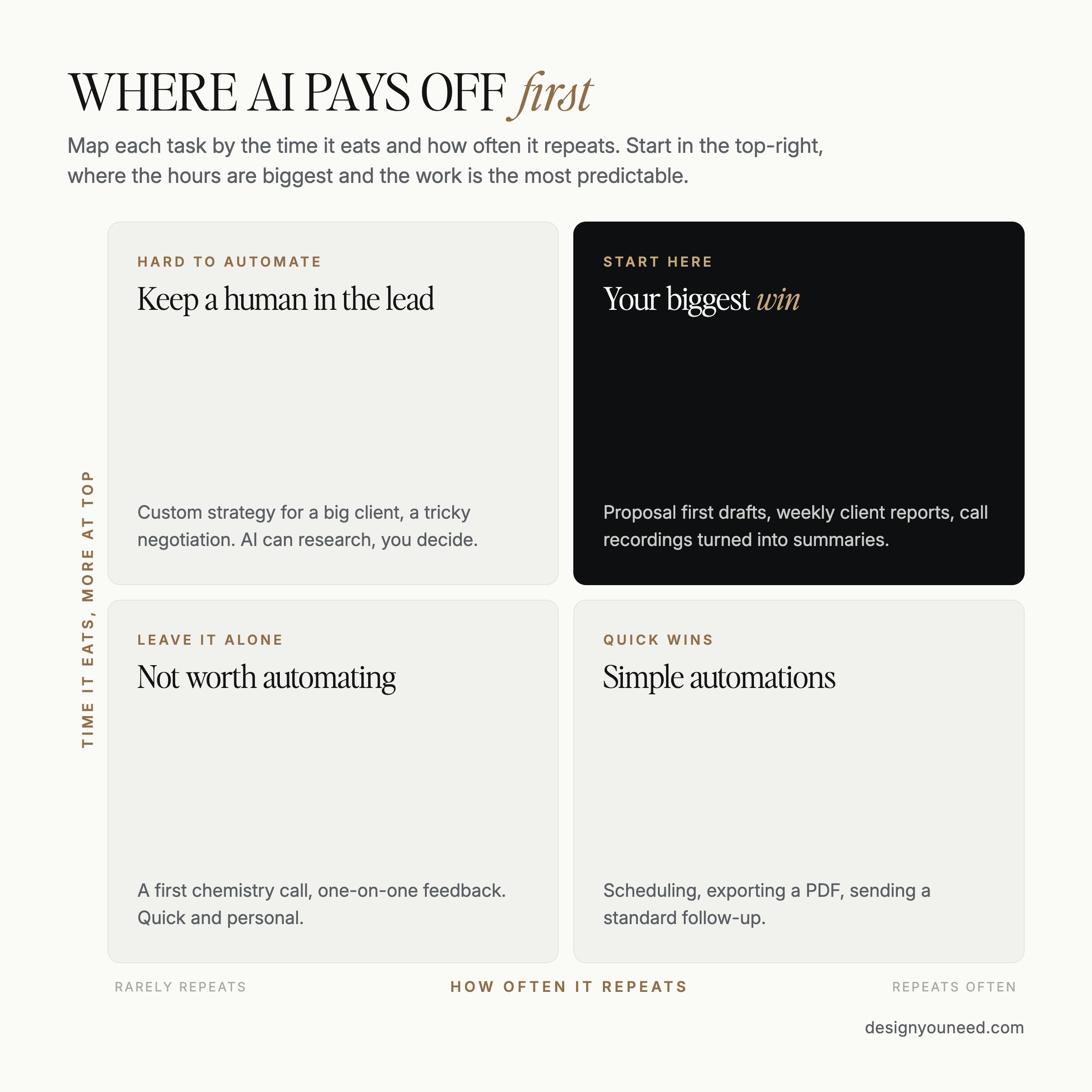
Now, you can take the tasks from your inventory and place them on this map. This single exercise will bring a huge amount of clarity to your thinking, showing you not just what you could do, but what you probably should do first.
How to map your tasks and find your highest-impact starting point
Plotting your tasks on the matrix will show you four distinct categories of work, each with a different implication for AI. Let’s walk through them with examples you might find in a typical service business.
Low Time, Low Repeatability: Don’t automate
These are unique, quick tasks. Think of a first chemistry call with a potential new client or giving a team member feedback in a one-on-one meeting. These tasks are in the bottom-left quadrant. They don’t take much time and they are highly dependent on context and human connection. Trying to automate them would be more work than it’s worth and would likely damage the personal touch that your business is built on.
High Time, Low Repeatability: Hard to automate
This top-left quadrant is for bespoke, complex work that forms the core of your expertise. This could be developing a custom brand strategy for a major client or navigating a difficult project negotiation. These tasks consume a lot of time and brainpower, but they are unique every time. While AI can certainly help with pieces of this work (like research or summarizing notes), the core strategic thinking requires a human in the lead.
Low Time, High Repeatability: Good for simple automations
The bottom-right quadrant contains the small, recurring tasks that happen all the time. This includes things like scheduling meetings, converting a document to a PDF, or sending standard follow-up emails. While none of these tasks takes very long on its own, their cumulative effect can be a steady drain on your team’s focus. These are perfect candidates for simple automations and basic AI tools that can handle the job with a simple instruction.
High Time, High Repeatability: Your best starting point
This is the top-right quadrant, and it’s where you’ll find your gold. These are the tasks that are both structured and incredibly time-consuming. For a service business, this might be creating first drafts of proposals, compiling weekly client status reports, or turning a long recording of a meeting into a summary with action items.
This quadrant is your highest-impact starting point. A successful project here will return a significant number of hours to your team, which they can then reinvest in the high-value strategic work that truly serves your clients and grows the business.
Your first AI project is a pilot, not a grand plan
Once you’ve identified a task in that “High Time, High Repeatability” quadrant, you have your pilot project. The key is to treat it as an experiment. You aren’t trying to rebuild your entire company overnight. You are running a small test on a well-understood, internal process to see how AI can help.
For instance, if proposal writing is your target, your pilot might be to find a tool that can take a standard template and a set of client notes and generate a solid first draft. Your team would still review, edit, and personalize it, but you could potentially reduce the writing time from 3 hours to 30 minutes. By starting with a contained, internal project, you lower the risk. You can learn how these tools work and how to write good instructions for them without affecting any client-facing work until you are confident in the results.
This simple diagnosis builds a real AI strategy
This process of looking inward does more than just give you a starting point. It’s the beginning of a genuine AI strategy for your business. When you repeat this task audit once or twice a year, you start to build a culture of continuous improvement, where your team is always looking for ways to devote more of their energy to the work that matters most.
You stop worrying about the hundreds of AI tools out there and instead develop a prioritized list of your business’s specific needs. Then, and only then, do you go looking for a tool to solve the problem you’ve already clearly defined. This approach ensures that any technology you bring into your business serves a clear purpose and helps you and your team do your best work.
The clarity you need to move forward with AI is already there, in the daily work of your business. Taking a week to map it out can feel like a pause, but it’s the kind of pause that lets you move much faster, and with more confidence, in the right direction.
If this methodical process feels like the clarity you’ve been looking for, the next step is to talk it through. I invite you to book a free 30-minute Strategy Call where we can discuss how an AI Readiness Audit could create a clear, prioritized plan for your business.